
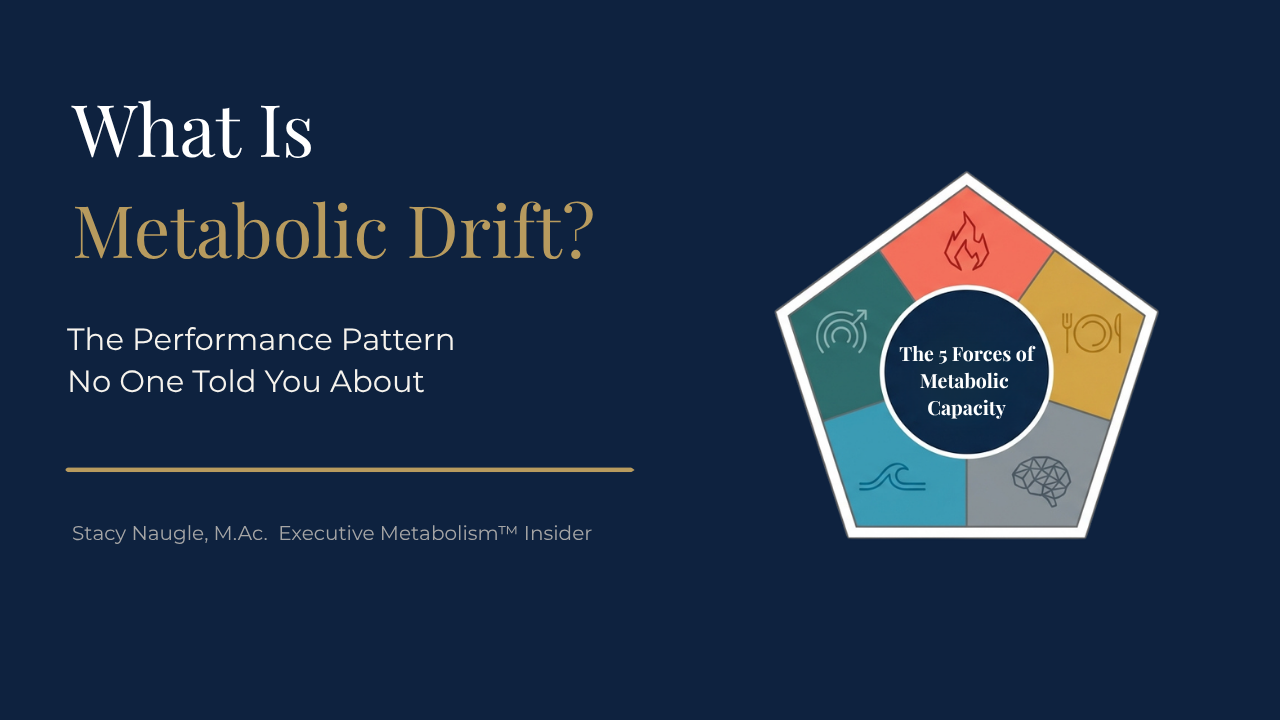
What Is Metabolic Drift? The Performance Pattern No One Told You About
Most high-achieving women spend 12–24 months attributing this to circumstance before they recognize it as a pattern. By then, it has cost them.
Metabolic Drift is the gradual, measurable decline of five integrated physiological systems governing energy generation, nutrient utilization, cognitive performance, stress and nervous system regulation, and identity/belief-driven physiology in professional women over 40.
It is not a disease. It does not appear on standard lab work. It is the clinical pattern explaining why accomplished women begin losing performance ground despite doing everything they have always done and why increasing effort can make it worse, not better.
The moment most executive women can identify
Ask a professional woman over 40 when she first noticed her energy or cognition had shifted, and most can tell you the exact month. There was no dramatic event. She just started not feeling like herself. Her energy levels and mental sharpness started taking more energy to maintain.
- The 2 pm flatness that used to be occasional is now predictable
- The morning sharpness that once ran until evening now runs out by noon
- The decision fatigue that used to appear under extreme pressure now appears on ordinary Tuesdays
- The body that used to respond to the same inputs of food, training, and sleep is storing more fat, despite efforts
Most women spend 12 to 24 months attributing this to circumstances: the difficult project, the heavy travel quarter, the stretch of poor sleep…
Then a new recognition arrives: this is not a circumstance. This is a pattern.
That pattern is Metabolic Drift.
What Metabolic Drift is and why it matters for your business performance
We developed the concept of Metabolic Drift after more than 30 years of clinical practice. It describes what I observed consistently in my most accomplished clients: a reproducible, measurable shift in metabolic capacity that was deeply underserved by both conventional medicine and generic wellness content.
Metabolic Drift is defined as: the cumulative, multi-system decline in metabolic capacity that occurs when the five integrated biological systems governing executive performance are simultaneously stressed beyond their recovery capacity.
Three words in that definition matter for your performance:
Cumulative — it accumulates over months and years, below the threshold of standard detection, until the gap between current function and previous baseline becomes impossible to ignore or compensate around.
Multi-system — medical test may appear within normal range in isolation. The dysfunction is in the integration. This is why single-lever interventions such as better sleep, more protein, and more exercise, produce limited results when metabolic drift is present across multiple systems simultaneously.
Capacity — this is not about disease. It is about the margin between where you are functioning and where you are capable of functioning. Metabolic Drift is a capacity problem, which means it has a precise solution.
To gain insight into your level of metabolic drift and the 5 forces impacting it, I invite you to take the Metabolic Capacity Assessment, a free, online 5-minute assessment.
The 5 Forces — mapped to executive performance outcomes
The five systems that function together to maintain your metabolic and performance capacity, and help you feel like yourself, are called the 5 Forces™. When one Force is challenged, the others can often compensate to maintain your level of performance, even if it feels like it takes more effort to do so. Over time and with sustained stress combined with midlife changes, your ability to compensate may be overcome, and what were once occasional disruptions in your energy level or cognition, now become common.
These are the 5 Forces of Metabolic Capacity:
FIRE: Energy Generation and Output Capacity. When FIRE drifts, our energy declines and becomes unstable. We are using more energy than we can create. Rest doesn’t rejuvenate us like it once did. The problem is not recovery, it is cellular energy generation.
FUEL: Nutrient Stability and Utilization. When FUEL drifts, we often experience digestive symptoms, food cravings, and post-meal energy crashes. In an effort to lose midlife fat gain, many women reduce calories, restrict their diets, or reduce their eating window with longer intermittent fasting times. Physiologically, there may be nutrient gaps or brain and muscle tissue may have difficulty accessing nutrients even when intake is adequate, because the delivery and absorption systems are impaired.
FOCUS: Cognitive and Neural Performance. When FOCUS drifts, the pattern is specific and predictable: clear thinking in the morning, progressive friction through the afternoon, decision fatigue that arrives earlier than it should, and eventually does not respond to caffeine or sugar. A 2022 review in Neurology found elevated neuroinflammatory markers in women during the menopausal transition that correlated with measurable declines in working memory and processing speed.
FLOW: Cortisol and Autonomic Regulation. When FLOW drifts, recovery from every stressor, physical, cognitive, emotional, takes longer than it should and eventually stops happening fully. Research in Psychoneuroendocrinology found that chronic stress in midlife women produces HPA axis dysregulation that persists even when acute stressors resolve, meaning the system loses its ability to self-correct, rest, digest, and repair.
FREEDOM: Identity-Level Recalibration. Many high-achieving women carry specific, identifiable patterns and beliefs that drove them to their level of success. In midlife, we often reflect more deeply on our values and beliefs, revealing where they no longer serve us. We may recognize them as self-sacrifice, workaholic behaviors, self-sabotage, or keeping ourselves small to make others comfortable. These are often subconscious, but still drive our behavior and can trigger the same physiological effect as external stressors. When FREEDOM drifts, no surface-level protocols hold.
Why single-system approaches fail and what precision assessment changes
Metabolic Drift is not caused by five separate problems. It is one integrated dysfunction expressed across five systems. For example, when FLOW Force is drifting, cortisol elevation increases insulin resistance (FOCUS), impairs gut absorption (FUEL), and suppresses mitochondrial biogenesis (FIRE).
Improving nutrition without addressing cortisol dysregulation produces limited results because the mechanism driving nutrient depletion is still active. The intervention is real. The biology simply cannot respond to it.
The central question is not what protocol to follow. It is which Force to address first. Pulling the wrong lever at the wrong time can inhibit recovery. In a system under stress, it often makes the overall pattern worse by adding demand that the system cannot process.
Precision over experimentation. Assessment before intervention.
This is the difference between sustainable metabolic recovery and the cycle most women experience: partial improvement, compensation, plateau, relapse.
Working with an MIT molecular biologist, we developed a Metabolic Capacity Assessment to identify your level of Metabolic Drift and the primary Force being impacted. It’s free, online, results are immediate and it takes about 5 minutes.

What Does Metabolic Drift Look Like?
Level 1 — Metabolic Resilience: Your training and recovery capacity are strong. Output and recovery are aligned, supporting metabolic efficiency and lean-tissue stability. You may notice mild changes in cognition or energy levels, or the effort needed to sustain them, but you can compensate well. Interventions at this stage are highly effective in restoring full capacity.
Level 2 — Early Metabolic Drift: Signs of inconsistent energy levels, afternoon brain fog, and slower recovery are emerging. Your system still adapts, but the margin is narrowing under work/family load. Optimization strategies are producing diminishing returns. Positive response times are typically fast at this stage.
Level 3 — Active Compensation: Significant daily impact. You find it takes longer to recover from high-intensity times, and afternoon performance is consistently harder to sustain. You may feel less confident in your ability to perform your job well and decline advancement opportunities. Most professional women who come to Executive Metabolism™ are here. System imbalances are more complex at this stage, but are still responsive.
Level 4 — Protection Dominance: Performance is substantially reduced, and you feel diminishing returns from your efforts. Wellness tips can no longer compensate, and you may feel like you’re running to stand still. You may blame yourself or consider quitting your job. The order of intervention is key at this stage because they system cannot handle further pressure.
Level 5 — Metabolic Protection Mode: Your system is rationing energy for the systems that need it most. Performance is substantially reduced, and you can no longer compensate by working harder. A long weekend off isn’t enough to rejuvenate you. You may worry about burnout and wonder if you will ever feel like yourself again. All 5 Forces are significantly impacted. Our experience is that a precise, individualized protocol is most effective for restoration over 3-6 months.
These are general descriptions. You may have different symptoms because each woman is unique.
Midlife brings change, and when we have worked toward excellence in our professions and perhaps grown a family along side it, the sustained effort and stress can amplify the changes that accompany perimenopause and menopause. How we address it, depends on your unique interplay of the 5 Forces.
A recent article in the Harvard Business Review shared the benefit of addressing metabolic drift in perimenopause is that we emerge more resilient, stronger and more stable in our menopausal years.
Frequently asked questions
How is Metabolic Drift different from burnout?
Burnout is “physical, emotional or mental exhaustion, accompanied by decreased motivation, lowered performance and negative attitudes toward oneself and others,” as defined by the American Psychological Association’s Dictionary of Psychology.
Metabolic Drift is a physiological pattern describing measurable multi-system functional decline. They can coexist and often do, but they require different interventions. You can remove the circumstances causing burnout and still have full Metabolic Drift. Addressing it requires biological precision, not just circumstantial change.
Can I have Metabolic Drift if I am not yet in menopause?
Yes. Perimenopause, which typically begins in the early-to-mid 40s, often years before irregular periods, is the period of greatest metabolic disruption. Estrogen fluctuation, not just decline, is the primary driver of early Metabolic Drift. Many women experience their most significant symptoms before a clinical menopause diagnosis.
How do I find out which Force is my primary constraint?
The free Executive Metabolic Capacity Assessment was designed specifically to identify primary Force drift in professional women over 40, in five minutes.
Written by Stacy Naugle, M.Ac. — Founder of Executive Metabolism™ and creator of the 5 Forces of Metabolic Capacity™.
Stacy Naugle, M.Ac. is the Founder and Chief Metabolic Strategist of Executive Metabolism™, a precision metabolic advisory firm for high-performing women 40+. A Licensed East Asian Medicine Practitioner with 30+ years of clinical experience, Stacy developed the 5 Forces Framework™ to address the specific physiological changes of perimenopause, active menopause, and postmenopause. She has guided hundreds of women through metabolic recalibration and serves as a sought-after advisor for executive women navigating midlife performance transition.
References
-
McEwen BS, Wingfield JC. The concept of allostasis in biology and biomedicine. Horm Behav. 2003;43(1):2–15.
-
Sterling P, Eyer J. Allostasis: A new paradigm to explain arousal pathology. In: Fisher S, Reason J, eds. Handbook of Life Stress, Cognition and Health. New York, NY: John Wiley & Sons; 1988:629–649.
-
Juster RP, McEwen BS, Lupien SJ. Allostatic load biomarkers of chronic stress and impact on health and cognition. Neurosci Biobehav Rev. 2010;35(1):2–16.
-
Chrousos GP. Stress and disorders of the stress system. Nat Rev Endocrinol. 2009;5(7):374–381.
-
Weber MT, Maki PM, McDermott MP. Cognition and mood in perimenopause: a systematic review and meta-analysis. Neurology. 2014;83(10):1007–1016.
-
Santoro N, Epperson CN, Mathews SB. Menopausal symptoms and their management. Endocrinol Metab Clin North Am. 2015;44(3):497–515.
-
Maki PM, Henderson VW. Cognition and the menopause transition. Menopause. 2016;23(7):803–805.
-
Greendale GA, Derby CA, Maki PM. Perimenopause and cognition. Obstet Gynecol Clin North Am. 2011;38(3):519–535.
-
Brinton RD, Yao J, Yin F, Mack WJ, Cadenas E. Perimenopause as a neurological transition state. Nat Rev Endocrinol. 2015;11(7):393–405.
-
Freeman EW, Sammel MD, Lin H, Nelson DB. Associations of hormones and menopausal status with depressed mood in women with no history of depression. Arch Gen Psychiatry. 2006;63(4):375–382.
-
Thurston RC, Joffe H. Vasomotor symptoms and menopause: findings from the Study of Women’s Health Across the Nation. Obstet Gynecol Clin North Am. 2011;38(3):489–501.
-
Alberti KGMM, Eckel RH, Grundy SM, et al. Harmonizing the metabolic syndrome: a joint interim statement of the International Diabetes Federation Task Force on Epidemiology and Prevention et al. Circulation. 2009;120(16):1640–1645.
-
Koliaki C, Roden M. Alterations of mitochondrial function and insulin sensitivity in human obesity and diabetes mellitus. Annu Rev Nutr. 2016;36:337–367.
-
Petersen MC, Shulman GI. Mechanisms of insulin action and insulin resistance. Physiol Rev. 2018;98(4):2133–2223.
-
Karvinen S, Jergenson MJ, Hyvärinen M, et al. Menopause transition and cardiometabolic health: a longitudinal study. Endocr Connect. 2023;12(2):e220513.
-
Lupien SJ, Maheu F, Tu M, Fiocco A, Schramek TE. The effects of stress and stress hormones on human cognition: implications for the field of brain and cognition. Brain Cogn. 2007;65(3):209–237.
-
Sapolsky RM. Why Zebras Don’t Get Ulcers. 3rd ed. New York, NY: Henry Holt and Company; 2004.
-
Epel ES, Blackburn EH, Lin J, et al. Accelerated telomere shortening in response to life stress. Proc Natl Acad Sci U S A. 2004;101(49):17312–17315.
-
Selye H. The Stress of Life. New York, NY: McGraw-Hill; 1956.
-
Grandey AA, Decker M, Barnes-Farrell JL, Stockdale MS. New research on how women in leadership navigated menopause. Harv Bus Rev. Published November 3, 2025.
This content is educational and informational. It does not constitute medical advice, diagnosis, or treatment.