
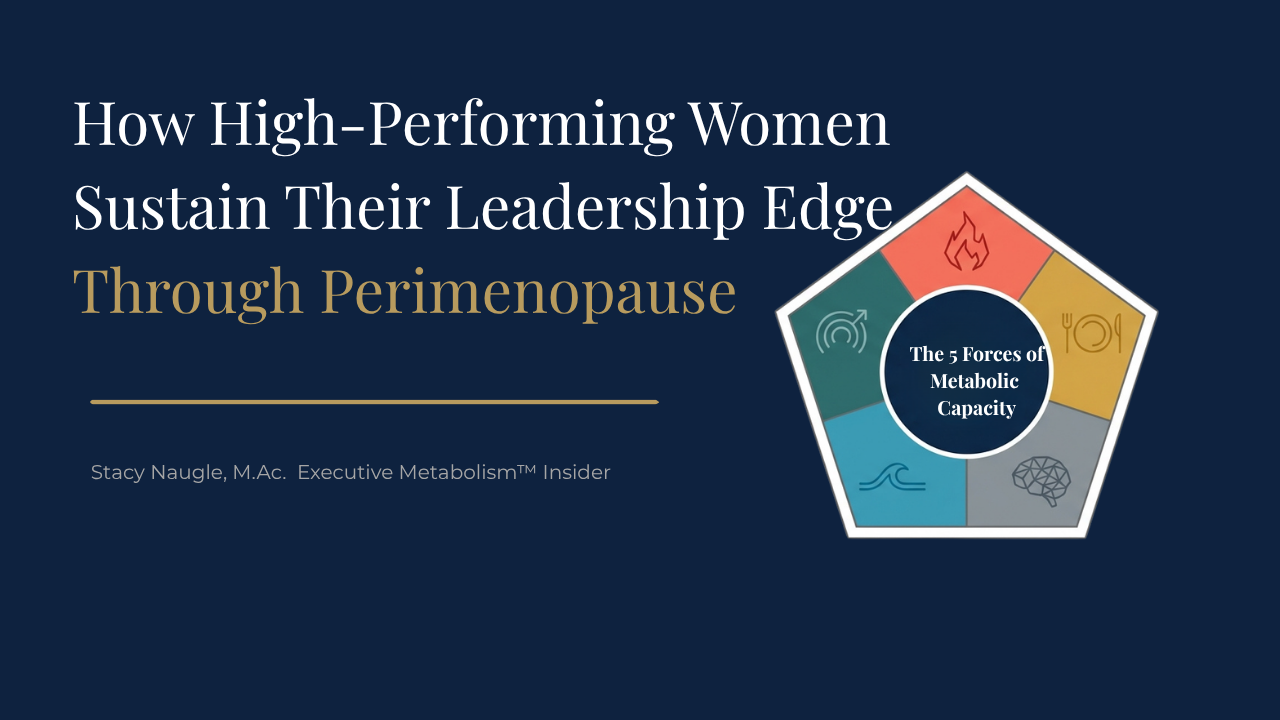
How High-Performing Women Over 40 Sustain Their Leadership Edge Through Perimenopause and Beyond
The most expensive performance problem you have may be invisible on standard lab work — because it was never designed to find it.
If you are a high-achieving woman over 40 who has noticed her edge slipping — not dramatically, not suddenly, but unmistakably — and your doctor has told you your results are normal, this article explains the gap between what medicine measures and what you are actually experiencing. That gap has a name: Metabolic Drift. It is measurable, addressable, and entirely distinct from aging.
The performance gap your labs will not explain
Picture a woman at the peak of her career. She runs a team, manages high-stakes relationships, delivers under pressure. She has always been able to count on her edge — the cognitive sharpness, the sustained focus, the physical resilience that lets her perform at the level she has built her reputation on.
Something shifts. Not dramatically. Gradually. The morning clarity that used to run until 6pm now fades by 2. The strategic thinking that once felt effortless now costs more than it returns. The body that used to recover from a hard week by Saturday morning now takes most of the weekend.
She goes to her doctor. Labs come back normal. She is told to sleep more and stress less.
She leaves with the same performance decline and a new confusion: if everything is normal, why is she losing ground?
Here is the answer: normal is a population average. It is not your optimal. And the gap between normal and optimal is where executive performance is won or lost.
What standard medicine measures, and what it misses
Standard lab panels were designed to detect disease. They were not designed to measure the subclinical, multi-system performance decline that occurs when a high-functioning woman's metabolic capacity begins to shift under sustained professional pressure at midlife.
Specifically, standard panels do not measure:
Mitochondrial efficiency — your cells' ability to convert fuel into usable energy at the rate your performance demands. You can have a normal metabolic panel and a 30–40% reduction in cellular energy output simultaneously.
Brain glucose delivery — standard fasting glucose tells you nothing about how efficiently your brain is accessing fuel across a high-demand workday. Normal fasting glucose can coexist with significant midday cognitive decline.
Cortisol patterning — a single cortisol test is a snapshot. It tells you nothing about the diurnal rhythm governing your energy architecture, sleep quality, and insulin sensitivity across the day. Dysregulated cortisol patterning is among the most common findings in high-performing women over 40, and it rarely triggers concern on standard labs.
The compounding cost of sustained high performance — no lab measures the chronic physiological burden of decades of elite-level professional output. But that burden is real, measurable, and among the primary drivers of the performance decline your doctor cannot explain.
→ Take the free Executive Metabolic Capacity Assessment to identify which biological system is limiting your performance:
The five biological systems governing your executive performance
Metabolic Drift is the cumulative decline of five integrated biological systems I have identified — through 30 years of clinical practice — as the primary determinants of performance capacity in professional women over 40. I call these the 5 Forces of Metabolic Capacity™.
FIRE — Mitochondrial energy generation. When this drifts, exhaustion becomes your baseline regardless of how much you sleep. The problem is not rest. It is cellular energy production.
FUEL — Metabolic nutrition architecture. Not calories. The specific micronutrients and absorption capacity your brain and muscles require to perform at demand level. You can eat well and still be metabolically under-resourced.
FOCUS — Cognitive and neural performance. Blood sugar stability, neuroinflammation, brain fuel delivery. When this drifts, your strategic thinking degrades in the afternoon whether you want it to or not.
FLOW — Cortisol regulation and nervous system recovery. When this drifts, you are in a permanent low-grade stress state that overrides every optimization you attempt. Sleep, nutrition, and exercise all underperform because the recovery system cannot activate.
FREEDOM — Identity-level metabolic recalibration. The chronic physiological cost of the psychological beliefs and inner narratives high-achieving women carry like the drive to be indispensable, resistance to self-care, putting others first or the reluctance to acknowledge decline.
These generate real cortisol and real inflammation, and no surface-level protocol resolves them.
Why this matters more at midlife and why increasing effort may make it worse
Estrogen is not just a reproductive hormone. It is a metabolic regulator that influences insulin sensitivity, mitochondrial function, brain glucose uptake, and cortisol response. As it shifts in perimenopause and menopause, which often begins years before obvious symptoms, every Force becomes more sensitive to the demands that were previously well-tolerated.
A 2021 study in Menopause found that women in the menopausal transition showed significant declines in insulin sensitivity even without changes in diet or exercise. The system changed. The behaviors did not. The results did.
The instinct of every high-achiever when performance declines is to apply more discipline, restriction, optimization, and effort. When medium to high levels Metabolic Drift are present, this is the wrong response.
More effort applied to an under-resourced system does not accelerate recovery. It accelerates depletion.
Precision over effort. Assessment before intervention. That is the difference between sustainable recovery and the exhausting cycle of partial improvement and relapse.
Frequently asked questions
Can Metabolic Drift be detected on standard blood tests?
Standard labs measure clinical markers of disease, not subclinical performance decline. Metabolic Drift typically falls within normal ranges on standard panels while producing significant, measurable performance impairment. Pattern assessment and functional medicine approaches are more sensitive to its presence. You can learn more about Metabolic Drift in this article.
Is what I am experiencing just normal aging?
Metabolic capacity changes with age, but the rate and severity are significantly influenced by addressable factors: hormonal transition, chronic stress load, nutritional gaps, mitochondrial efficiency, and nervous system regulatory capacity. What most women experience as 'normal aging' is largely Metabolic Drift — and it is not a fixed trajectory.
Why does this seem to affect high-achieving women specifically?
Sustained high performance — the chronic cognitive and physiological demands of executive-level professional life — places compounding stress on the same biological systems most affected by midlife hormonal transition. The interaction between sustained professional stress and the metabolic effects of perimenopause creates a pattern of dysfunction distinct from what lower-stress women experience.
What is the first step?
The free Executive Metabolic Capacity Assessment identifies which of the 5 Forces is your primary performance constraint in five minutes, and provides a personalized starting point.
Written by Stacy Naugle, M.Ac. — Founder of Executive Metabolism™ and creator of the 5 Forces of Metabolic Capacity™.
Stacy Naugle, M.Ac. is the Founder and Chief Metabolic Strategist of Executive Metabolism™, a precision metabolic advisory firm for high-performing women 40+. A Licensed East Asian Medicine Practitioner with 30+ years of clinical experience, Stacy developed the 5 Forces Framework™ to address the specific physiological changes of perimenopause, active menopause, and postmenopause. She has guided hundreds of women through metabolic recalibration and serves as a sought-after advisor for executive women navigating midlife performance transition.
References
-
McEwen BS, Wingfield JC. The concept of allostasis in biology and biomedicine. Horm Behav. 2003;43(1):2–15.
-
Sterling P, Eyer J. Allostasis: A new paradigm to explain arousal pathology. In: Fisher S, Reason J, eds. Handbook of Life Stress, Cognition and Health. New York, NY: John Wiley & Sons; 1988:629–649.
-
Juster RP, McEwen BS, Lupien SJ. Allostatic load biomarkers of chronic stress and impact on health and cognition. Neurosci Biobehav Rev. 2010;35(1):2–16.
-
Chrousos GP. Stress and disorders of the stress system. Nat Rev Endocrinol. 2009;5(7):374–381.
-
Sapolsky RM. Why Zebras Don’t Get Ulcers. 3rd ed. New York, NY: Henry Holt and Company; 2004.
-
Petersen MC, Shulman GI. Mechanisms of insulin action and insulin resistance. Physiol Rev. 2018;98(4):2133–2223.
-
Koliaki C, Roden M. Alterations of mitochondrial function and insulin sensitivity in human obesity and diabetes mellitus. Annu Rev Nutr. 2016;36:337–367.
-
Brinton RD, Yao J, Yin F, Mack WJ, Cadenas E. Perimenopause as a neurological transition state. Nat Rev Endocrinol. 2015;11(7):393–405.
-
Weber MT, Maki PM, McDermott MP. Cognition and mood in perimenopause: a systematic review and meta-analysis. Neurology. 2014;83(10):1007–1016.
-
Maki PM, Henderson VW. Cognition and the menopause transition. Menopause. 2016;23(7):803–805.
-
Greendale GA, Derby CA, Maki PM. Perimenopause and cognition. Obstet Gynecol Clin North Am. 2011;38(3):519–535.
-
Santoro N, Epperson CN, Mathews SB. Menopausal symptoms and their management. Endocrinol Metab Clin North Am. 2015;44(3):497–515.
-
Thurston RC, Joffe H. Vasomotor symptoms and menopause: findings from the Study of Women’s Health Across the Nation. Obstet Gynecol Clin North Am. 2011;38(3):489–501.
-
El Khoudary SR, Aggarwal B, Beckie TM, et al. Menopause transition and cardiovascular disease risk: implications for timing of early prevention. Circulation. 2020;142(25):e506–e532.
-
Matthews KA, Crawford SL, Chae CU, et al. Are changes in cardiovascular disease risk factors in midlife women due to chronological aging or to the menopausal transition? J Am Coll Cardiol. 2009;54(25):2366–2373.
-
Janssen I, Powell LH, Crawford S, Lasley B, Sutton-Tyrrell K. Menopause and the metabolic syndrome: the Study of Women’s Health Across the Nation. Arch Intern Med. 2008;168(14):1568–1575.
-
Karvinen S, Jergenson MJ, Hyvärinen M, et al. Menopause transition and cardiometabolic health: a longitudinal study. Endocr Connect. 2023;12(2):e220513.
-
Freeman EW, Sammel MD, Lin H, Nelson DB. Associations of hormones and menopausal status with depressed mood in women with no history of depression. Arch Gen Psychiatry. 2006;63(4):375–382.
-
Lupien SJ, Maheu F, Tu M, Fiocco A, Schramek TE. The effects of stress and stress hormones on human cognition: implications for the field of brain and cognition. Brain Cogn. 2007;65(3):209–237.
-
Epel ES, Blackburn EH, Lin J, et al. Accelerated telomere shortening in response to life stress. Proc Natl Acad Sci U S A. 2004;101(49):17312–17315.
-
Selye H. The Stress of Life. New York, NY: McGraw-Hill; 1956.
-
Grandey AA, Decker M, Barnes-Farrell JL, Stockdale MS. New research on how women in leadership navigated menopause. Harv Bus Rev. Published November 3, 2025.
This content is educational and informational. It does not constitute medical advice, diagnosis, or treatment.