
Why Focus and Cognitive Performance Changes in Perimenopause
If you've noticed that your 2pm is different than it used to be and that the sharp, reliable cognitive performance you built your career on now requires more active management, you are not imagining it. And you are not alone.
Sixty-three percent of women in perimenopause report not feeling like themselves at least half the time, with fatigue, brain fog, and cognitive difficulty among the most frequently cited experiences (Women Living Better Annual Survey, published in Menopause, 2024,).
This is not a character change. It is a physiological one. And the mechanism behind it, the reason your focus and mental clarity are less consistent in your 40s, involves a system that almost no one discusses in the context of women's cognitive performance: insulin signaling.
This article explains what the research shows about the insulin-brain connection, why it changes during midlife transition, and what it means for high-performing women who need sustained cognitive output as a professional requirement.
What Is the Insulin Performance Gap?
The "Insulin Performance Gap" is a term I use to describe the measurable decline in insulin signaling precision that occurs during perimenopause and postmenopause — and its direct downstream effect on executive function, working memory, and emotional regulation.
Most people associate insulin with blood sugar and diabetes risk. The research reveals something more immediately relevant: insulin is a primary regulator of brain energy metabolism. Insulin receptors are found throughout the brain, including in the hippocampus (memory), the prefrontal cortex (executive function and decision-making), and the amygdala (emotional regulation under pressure).
When insulin signaling is precise and efficient, glucose — the brain's primary fuel — is delivered consistently to these regions. Cognitive function feels effortless, automatic, and reliable.
When insulin signaling becomes less precise, glucose delivery becomes inconsistent. The windows of peak cognitive performance shorten. Emotional steadiness under pressure requires more effort. The decision quality that once felt automatic now requires active management.
This is the Insulin Performance Gap. And it has a clear physiological driver.
How Estrogen Loss Changes the Insulin-Brain Relationship
Estrogen does not simply influence reproductive function. It is a direct regulator of insulin sensitivity across multiple organ systems, including the brain.
Research published in the Journal of Midlife Health (2025) confirms that estrogen supports insulin signaling through multiple mechanisms: PI3K/Akt pathway activation (which governs GLUT-4 translocation — the mechanism by which cells take up glucose), AMPK activation (which drives energy metabolism in muscle and brain), and direct estrogen receptor activity in metabolic tissues including the liver, skeletal muscle, and intestine (Kaur et al., J Midlife Health, 2025).
As estrogen declines during perimenopause, each of these mechanisms is progressively impaired. The result is a gradual reduction in insulin sensitivity, meaning the brain and body require more insulin to achieve the same glucose uptake that was previously automatic.
The consequences for cognitive performance are measurable. In a landmark neuroimaging study at Weill Cornell Medicine, Dr. Lisa Mosconi and colleagues used PET and MRI imaging to assess brain structure, connectivity, and energy metabolism in 161 women across premenopausal, perimenopausal, and postmenopausal stages. The findings were unambiguous: perimenopausal and postmenopausal women showed significant reductions in cerebral glucose metabolism, brain volume in memory-critical regions, and functional connectivity; changes that were specific to endocrine aging (the hormonal transition), not simply chronological aging (Mosconi et al., Scientific Reports, 2021).
In other words, what is happening to your focus after 40 is not simply aging. It is a specific, estrogen-mediated change in how your brain accesses and uses its primary fuel.
What the Insulin Performance Gap Feels Like
In clinical practice, I describe the Insulin Performance Gap through a constellation of experiences that high-performing women recognize immediately:
The 2pm threshold. Peak cognitive performance runs reliably through the morning but begins to deteriorate predictably in the early-to-mid afternoon. Decisions that would have been crisp become heavier. Complex problem-solving requires more deliberate effort.
Post-meal cognitive dip. Within 60-90 minutes of eating, particularly after carbohydrate-dominant meals, a noticeable shift in mental clarity occurs. This corresponds to the postprandial glucose spike and the subsequent insulin response, which temporarily impairs prefrontal cortex function.
Emotional steadiness erosion. The amygdala, our brain's threat-detection center, has a higher activation threshold when insulin-mediated glucose delivery to the prefrontal cortex is optimal. As insulin performance declines, the prefrontal cortex's ability to regulate amygdala reactivity diminishes. High-performing women notice this as heightened emotional reactivity under pressure, or a reduced ability to access the calm, strategic thinking that defined their leadership.
Recovery time extension. After a cognitively demanding day, the restoration of mental clarity takes longer. A night of sleep that previously felt restorative no longer completely clears the cognitive residue of a demanding day.

The Caffeine Compensation Pattern
Most high-performing women with an Insulin Performance Gap develop a caffeine compensation pattern, using coffee to override the cognitive dip rather than addressing its physiological root.
This pattern creates a secondary problem. Caffeine consumed immediately upon waking suppresses the natural cortisol awakening response (CAR), a timed morning cortisol peak that provides genuine alertness and drives the day's metabolic rhythm. When caffeine is consumed during the CAR peak, the body's natural alertness mechanism is blunted, leading to a more pronounced mid-morning energy plateau and an earlier afternoon crash.
Research on cortisol and caffeine timing consistently supports delaying the first coffee by 60–90 minutes after waking — allowing the CAR to complete its natural peak before adding caffeine's additional stimulation (Lovallo et al., multiple publications on caffeine and HPA axis). The result is better sustained cognitive performance through the afternoon, without increasing total caffeine intake.
How Can I Keep My Blood Sugar Steady?
The Insulin Performance Gap is not reversed by willpower or caffeine management alone. It requires addressing the physiological mechanism of insulin resistance through targeted nutritional, metabolic, and lifestyle interventions specific to the post-40 female physiology.
Meal sequencing. Multiple peer-reviewed studies confirm that consuming vegetables and fiber-rich foods before protein, and protein before carbohydrates, reduces the postprandial glucose spike by 20–37% compared to consuming carbohydrates first. In women with impaired insulin sensitivity, this simple sequencing change meaningfully reduces the post-meal cognitive dip (Shukla et al., Diabetes Care, 2017; Imai et al., BMJ Open Diabetes Research & Care, 2016).
Post-meal movement. A 10–15 minute walk within 30 minutes of eating activates GLUT-4 translocation in skeletal muscle, a non-insulin-mediated pathway for glucose clearance that directly reduces postprandial glucose levels and the cognitive fog associated with them (Colberg et al., Diabetes Care, 2009).
Protein prioritization at breakfast. Consuming 25–35g of protein at the first meal of the day stabilizes blood sugar through the morning by reducing glucose-dependent energy spikes and supporting the insulin sensitivity required for consistent cognitive performance. This aligns with recommendations from exercise physiologist Dr. Stacy Sims, whose research on perimenopausal and postmenopausal women consistently supports early-day protein loading as a metabolic priority.
Heavy resistance training. Skeletal muscle is the primary site of insulin-mediated glucose uptake. Building and maintaining muscle mass through progressive resistance training at sufficient intensity directly improves insulin sensitivity and the consistency of glucose delivery to the brain. Dr. Sims's research is explicit: for women in the menopausal transition, resistance training at challenging loads (not moderate exercise) is the required stimulus for metabolic adaptation (Next Level, Sims & Yeager, 2022; research published through AUT University and University of Waikato).
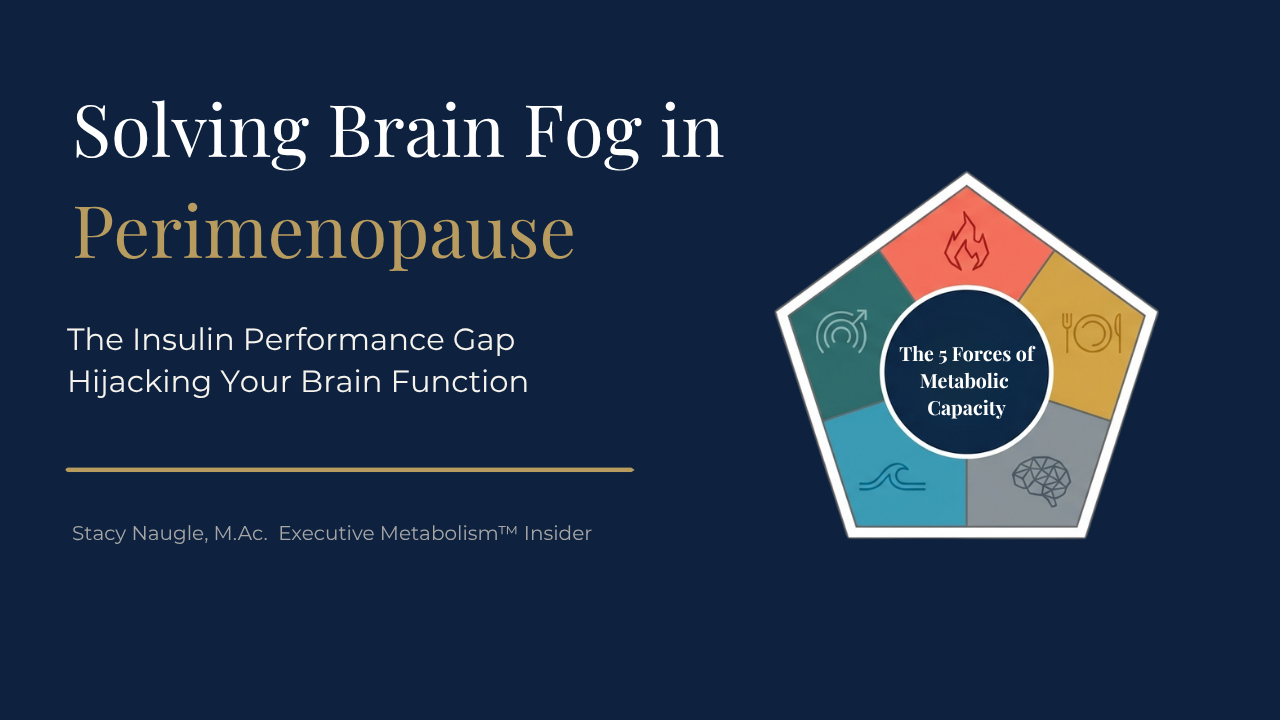
The FOCUS Force in the 5 Forces of Metabolic Capacity Framework™
At Executive Metabolism™, we call this system the FOCUS Force, one of five interconnected physiological systems we assess in every client's metabolic profile.
The FOCUS Force encompasses insulin performance, brain glucose metabolism, NAD+ availability in neural tissue, and the prefrontal cortex's capacity for sustained executive function. When the FOCUS Force is constrained, all other performance efforts are built on an unstable foundation.
The critical insight, and the reason most performance programs produce only partial, temporary results, is that the FOCUS Force does not function in isolation. It is downstream of the FUEL Force (nutrient acquisition, processing, and delivery) and adjacent to the FIRE Force (cellular energy generation). Addressing cognitive performance without addressing the nutritional and cellular energy systems that supply it produces improvements that plateau.
This is the systems view of executive performance that the 5 Forces Framework makes visible.
Take the Free Executive Metabolic Capacity Assessment
🧠 DISCOVER YOUR LEVEL OF METABOLIC DRIFT AND FUNCTION LEVEL OF EACH OF THE 5 FORCES
The Executive Metabolic Capacity Assessment maps all five of your performance systems, including your FOCUS Force, and identifies your Metabolic Drift Level in 5 minutes.
Your results include a personalized profile showing where your performance capacity is strongest, where it is most constrained, and which system to address first.
→ Take the free Executive Metabolic Capacity Assessment to identify which biological system is limiting your performance:
Frequently asked questions
What is the insulin performance gap? The insulin performance gap describes the decline in insulin signaling precision that occurs during perimenopause and postmenopause, and its direct effect on brain function. Insulin is a regulator of glucose delivery to the brain. When insulin signaling becomes less precise, cognitive performance becomes less consistent.
Does menopause cause brain fog? Research including neuroimaging studies at Weill Cornell confirms that the menopausal transition is associated with measurable changes in brain energy metabolism, including reduced cerebral glucose metabolism in memory and cognitive regions. Brain fog during perimenopause and menopause has a documented physiological basis.
Can diet affect cognitive performance in menopause? Yes. Meal composition and sequencing have documented effects on postmeal glucose levels, which directly affect brain function. Consuming protein and fiber before carbohydrates reduces post-meal glucose spikes and the cognitive impairment associated with them.
Is brain fog after 40 permanent? No. The physiological changes associated with the menopausal transition are addressable through specific lifestyle, nutritional, and metabolic interventions. Neuroimaging research suggests that the optimal window for intervention is during the perimenopausal transition, though postmenopausal women also show response to metabolic interventions.
What is the FOCUS Force? The FOCUS Force is Executive Metabolism™'s term for the physiological system governing insulin performance, brain glucose metabolism, and sustained executive cognitive function. It is one of five interconnected systems assessed in the Executive Metabolic Capacity Assessment.

Written by Stacy Naugle, M.Ac. — Founder of Executive Metabolism™ and creator of the 5 Forces of Metabolic Capacity™.
Stacy Naugle, M.Ac. is the Founder and Chief Metabolic Strategist of Executive Metabolism™, a precision metabolic advisory firm for high-performing women 40+. A Licensed East Asian Medicine Practitioner with 30+ years of clinical experience, Stacy developed the 5 Forces Framework™ to address the specific physiological changes of perimenopause, active menopause, and postmenopause. She has guided hundreds of women through metabolic recalibration and serves as a sought-after advisor for executive women navigating midlife performance transition.
Scientific References
- Kaur N, et al. "Estrogen and Metabolism: Navigating Hormonal Transitions from Perimenopause to Postmenopause." J Midlife Health. 2025;16(3):247–256. doi:10.4103/jmh.jmh_75_25
- Mosconi L, Berti V, Dyke J, et al. "Menopause impacts human brain structure, connectivity, energy metabolism, and amyloid-beta deposition." Sci Rep. 2021;11(1):10867. doi:10.1038/s41598-021-90084-y
- Shukla AP, Iliescu RG, Thomas CE, Aronne LJ. "Food order has a significant impact on postprandial glucose and insulin levels." Diabetes Care. 2015;38(7):e98–e99.
- Colberg SR, Sigal RJ, Fernhall B, et al. "Exercise and type 2 diabetes." Diabetes Care. 2010;33(12):e147–167.
- Sims ST, Yeager S. Next Level: Your Guide to Kicking Ass, Feeling Great, and Crushing Goals Through Menopause and Beyond. Rodale Books, 2022.
- Women Living Better Annual Survey. "Not Feeling Like Myself: Midlife Women's Experiences During Perimenopause." Menopause. 2024. N=1,529.
- Lovallo WR, et al. "Caffeine stimulation of cortisol secretion across the waking hours in relation to caffeine intake levels." Psychosomatic Medicine. 2005;67(5):734–739.
This content is educational and informational. It does not constitute medical advice, diagnosis, or treatment.