
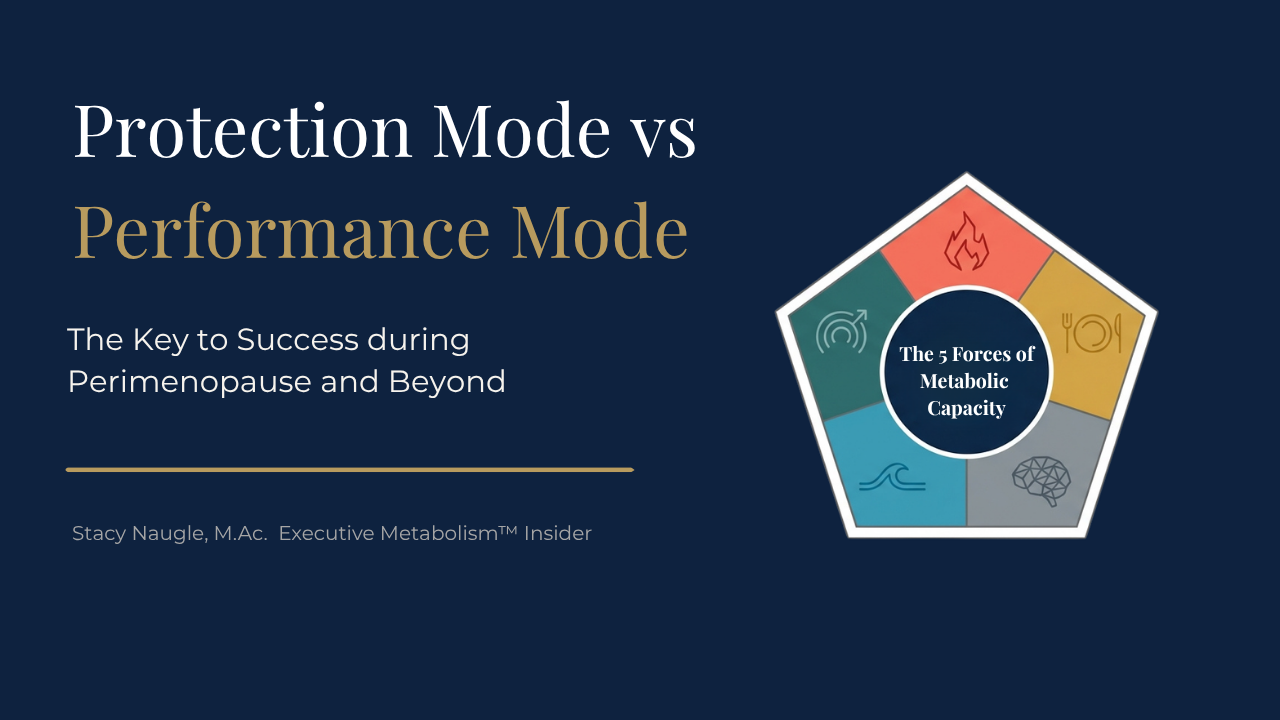
Protection Mode vs. Performance Mode: The Key to Success during Perimenopause and Beyond
If you have arrived at a point where you are quietly wondering whether the fatigue, the slower recovery, the performance that requires more effort than it used to, is simply who you are now, this article is for you.
What you may be experiencing is a state of Metabolic Drift your system has entered. And states are reversible.
After 30 years of clinical practice with high-performing women navigating midlife transition, I have seen this pattern more times than I can count. A woman who has spent decades operating at the peak of her cognitive and physical capacity enters a period where that capacity feels less reliable and interprets this as a personal failure rather than a physiological shift.
The interpretation is understandable. But it is incorrect.
What she is experiencing has a name, a mechanism, and a solution. We call it Protection Mode and understanding it changes everything.
What Is Protection Mode?
Protection Mode is our clinical description for the biological state a body enters when it detects sustained, unresolved demand without adequate recovery or fuel. This causes a shift from its primary objective from performance optimization to resource conservation.
This is not malfunction. It is biological intelligence.
The human body evolved sophisticated threat-detection and resource-management systems. When those systems detect a pattern of prolonged demand like chronic cognitive load, disrupted sleep, inadequate nutrition, or sustained stress activation they make a rational, survival-oriented decision: shift resources away from non-essential high-performance functions and toward preservation.
In Protection Mode, your body:
- Preferentially stores fat (particularly visceral fat — the most accessible energy reserve)
- Shifts the autonomic nervous system toward sympathetic dominance (activation) and away from parasympathetic (recovery and relaxation)
- Impairs insulin signaling to preserve glucose for critical functions
- Reduces anabolic (building) processes including muscle protein synthesis and tissue repair
None of these adaptations are mistakes. They are all logical responses to a perceived state of sustained threat or resource shortage.
The problem is that Protection Mode was designed for temporary crises, not for a decade of high-performance professional life during midlife hormonal transition and family life.
The Physiology Behind the Performance Mode
The transition from Performance Mode to Protection Mode has a clear biological driver in midlife women: the declining influence of estrogen on three interconnected systems.
The mitochondrial system. Estrogen supports the expression of PGC-1α — the master regulatory protein of mitochondrial biogenesis and efficiency. As estrogen declines, PGC-1α signaling decreases, mitochondrial efficiency drops, and the cells that were once generating abundant ATP on-demand begin producing energy more conservatively. The body does not generate energy waste it cannot afford. Protection Mode limits output to what the depleted system can sustain (Yu et al., Molecular Medicine Reports, 2025; Yokota et al., commentary in Acta Physiologica, 2024).
The autonomic nervous system. Estrogen directly supports vagal tone — the activity of the parasympathetic (rest-and-restore) nervous system. As estrogen declines, vagal tone measurably decreases and the system tilts toward sympathetic dominance. Research comparing pre- and postmenopausal women using heart rate variability (HRV) analysis consistently shows reduced parasympathetic activity and higher sympathetic tone in postmenopausal women compared to their premenopausal counterparts (Cross-sectional study, European Journal of Cardiovascular Medicine, 2024; PMC 9127980, 2022). This sympathetic tilt is Protection Mode in the autonomic system: the body is running alert, conserving, and not fully recovering.
The insulin performance optimization system. Reduced insulin sensitivity, which can occur progressively during perimenopause, shifts the body's fuel use toward carbohydrate dependence. Rather than efficiently burning fat for sustained energy, the body relies on carbohydrate for even moderate demands. This creates the characteristic energy volatility of Protection Mode: peaks followed by valleys, crashes, and the constant need for external stimulation like sugar and caffeine to maintain function.
Performance Mode: What You're Returning To
Performance Mode is not a state of relentless pushing. It is a state of physiological efficiency where the systems that generate and sustain performance are operating at their designed capacity.
In Performance Mode:
- Cellular energy (ATP) is generated efficiently from both fat and carbohydrate
- Insulin performance is optimized to deliver glucose consistently to the brain and working muscles
- The autonomic nervous system activates in response to demand and genuinely recovers between demands
- Sleep is restorative so that the body and brain complete their cellular repair work overnight
- Cognitive performance is reliable
- Stress response is proportionate; activated when appropriate, resolved and completed
Performance Mode is not a younger woman's biology. It is an optimized biology at any age.
The research confirms that the systems governing performance are responsive to intervention and that the window of greatest leverage is during perimenopause.
An article published in the Harvard Business Review concluded that menopause is not inherently a career barrier for women leaders. With proper support during perimenopause, many women emerge as stronger, more resilient, and more effective leaders during and after menopause.
Why Most Approaches Miss This
Most performance strategies, wellness programs, and health advice fail the high-performing woman in Protection Mode because they address outputs without addressing the system.
--> Telling a woman in Protection Mode to push harder with exercise increases the cortisol load on an already-taxed stress response system, deepening Protection Mode rather than reversing it. Research by Dr. Stacy Sims, exercise physiologist and author of Next Level, specifically identifies moderate-intensity sustained cardio as counterproductive for us because it creates a cortisol and energetic burden that exceeds its adaptive benefit. The body interprets it as additional demand, not recovery.
--> Restricting calories in response to body composition changes signals resource scarcity, one of the primary triggers for Protection Mode in the first place. Under-eating elevates cortisol, decreases muscle mass, and reinforces the fat-storage signals already active in Protection Mode.
--> Optimizing sleep in isolation without addressing the mitochondrial, insulin, and autonomic drivers of sleep disruption produces partial, temporary improvements. Protection Mode disrupts sleep as a consequence of its physiological mechanisms. Treating the sleep without treating the mechanism produces a fraction of the available benefit.
The fundamental error is sequential: addressing symptoms while the underlying system remains in Protection Mode. Performance returns when the system is recalibrated, not when individual outputs are managed.
→ Take the free Executive Metabolic Capacity Assessment to identify which biological system is limiting your performance:
The 5 Forces Framework™ and the Recalibration Sequence
At Executive Metabolism™, we map Protection Mode through five interconnected systems called the 5 Forces of Executive Metabolism™:
🔥 FIRE — mitochondrial energy generation and musculoskeletal capacity
⚡ FUEL — nutritional management, digestive function, and gut health
🧠 FOCUS — insulin performance and sustained cognitive capacity
🌊 FLOW — autonomic nervous system regulation and genuine recovery capacity
🌿 FREEDOM — stress-imprint patterns and inner narratives driving physiology
When all five Forces are operating optimally, the system is in Performance Mode.
When one Force drifts into deficit, it creates load on adjacent Forces --> The system compensates --> The compensation accumulates --> Protection Mode deepens.
The recalibration sequence matters.
For most women, the Force driving the cascade is not the Force producing the most obvious symptoms. For example, a woman whose most prominent experience is brain fog (FOCUS Force) may have a primary deficit in autonomic recovery (FLOW Force) that is impairing the neural recovery required for sustainable cognitive performance. Addressing FOCUS without addressing FLOW produces partial, temporary results.
Identifying the right Force sequence is the precision work of the Executive Metabolic Reset™ program. But it begins with the assessment.
The Executive Metabolic Capacity Assessment maps all five of your Forces and identifies your Metabolic Drift Level, how far your system has moved from Performance Mode toward Protection Mode, and in which direction the cascade is running.
5 minutes. Free. Instant Results.

Frequently asked questions
What does Protection Mode mean for my body?
Protection Mode is a biological state in which the body shifts from performance optimization to resource conservation. It involves reduced mitochondrial output, impaired insulin signaling, autonomic nervous system tilt toward sympathetic dominance, and preferential fat storage. It is a rational biological response to sustained demand — not a failure.
Is Protection Mode the same as burnout?
Protection Mode is the physiological state that underlies what is commonly called burnout. Burnout describes the experience; Protection Mode describes the biological mechanism producing it.
Can you recover from Protection Mode?
Yes. The physiological systems that shift into Protection Mode are responsive to intervention. Research supports specific, sequenced interventions — including resistance training, nutritional architecture, autonomic regulation practices, and sleep optimization — in restoring metabolic performance.
What is the difference between Protection Mode and aging?
Protection Mode is driven by specific physiological changes — primarily estrogen decline's effect on mitochondrial function, insulin sensitivity, and autonomic tone. These changes are measureable and addressable. Chronological aging is a separate process. Women in their 50s and 60s who address their metabolic systems report performance levels they describe as better than their 30s — because they are recalibrating the system, not just managing aging.
What is the 5 Forces Framework™?
The 5 Forces Framework™ is Executive Metabolism™'s proprietary system for assessing and recalibrating the five interconnected physiological systems that govern executive performance in women 40+: FIRE (mitochondrial energy), FUEL (nutritional architecture), FOCUS (insulin performance), FLOW (autonomic recovery), and FREEDOM (stress-imprint patterns).
Written by Stacy Naugle, M.Ac. — Founder of Executive Metabolism™ and creator of the 5 Forces of Metabolic Capacity™.
Stacy Naugle, M.Ac. is the Founder and Chief Metabolic Strategist of Executive Metabolism™, a precision metabolic advisory firm for high-performing women 40+. A Licensed East Asian Medicine Practitioner with 30+ years of clinical experience, Stacy developed the 5 Forces Framework™ to address the specific physiological changes of perimenopause, active menopause, and post-menopause. She has guided hundreds of women through metabolic recalibration and serves as a sought-after advisor for executive women navigating midlife performance transition.
References
- Yu S, Li C, Huang Z, et al. "Mitochondrial dysfunction in perimenopausal mood disorders: From hormonal shifts to neuroenergetic failure." Molecular Medicine Reports. 2025. PMC12513434.
- Yokota T. Commentary: "Skeletal muscle mitochondria: A potential target for postmenopausal hormone replacement therapy." Acta Physiologica. 2024;240(5):e14149. doi:10.1111/apha.14149
- Cross-sectional study: "A Comparative Cross-Sectional Study of Heart Rate Variability in Pre & Post Menopausal Women." European Journal of Cardiovascular Medicine. 2024.
- Sims ST, Yeager S. Next Level: Your Guide to Kicking Ass, Feeling Great, and Crushing Goals Through Menopause and Beyond. Rodale Books, 2022.
- Kaur N, et al. "Estrogen and Metabolism: Navigating Hormonal Transitions from Perimenopause to Postmenopause." J Midlife Health. 2025;16(3):247–256.